

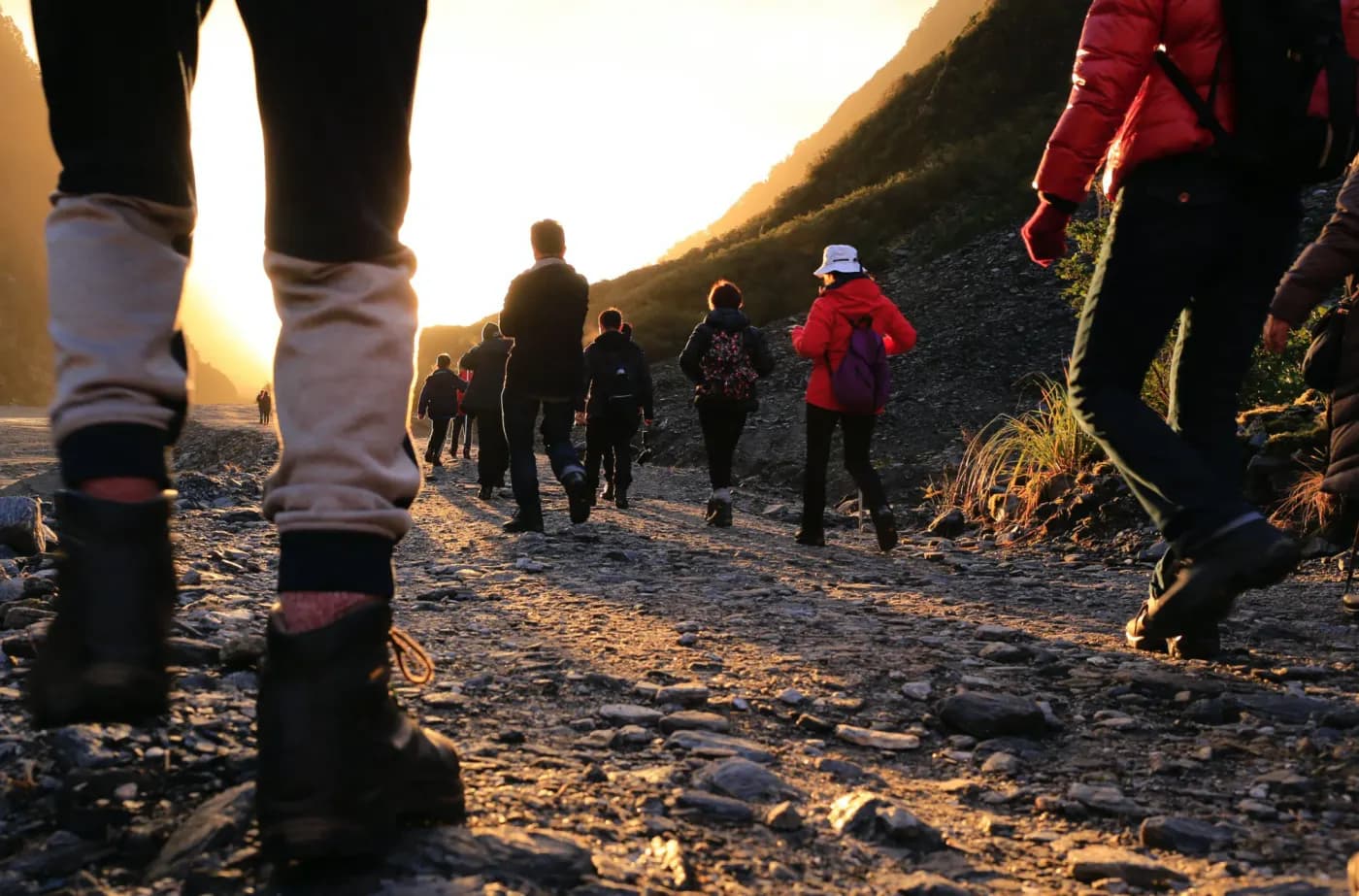
A way of travelling and getting around with the lowest possible impact.
The 2030 Agenda for Sustainable Development created by the United Nations sets out 30 global Sustainable Development Goals.
In this respect, we all accept that we need to protect the natural environment and reduce human impact in our daily lives. The United Nations goals take the environment into account, but also social impact, with goals such as reducing poverty, gender equality and equal opportunities in education, responsible consumption, and so on.
Today we want to introduce you to a new way of travelling, which isn't really that new, since it is how human beings have been getting around for millions of years: on foot.
Nowadays we use many different means of transport to travel, and most of them have a considerable environmental impact. Transport has harmful effects on the environment and on us as human beings, because of polluting gas emissions and also because of the infrastructure it requires, such as airports, roads and railway lines.
So, if we are aware that getting around has a negative impact on the environment and the natural surroundings, what can we do to reduce that impact?
Using means of transport that have no impact, or a very small one, is a challenge that we at Valua Travel invite you to take on. The means of transport with the lowest impact range from walking, which has zero impact in terms of infrastructure, to cycling, scooters or horse riding.
Here are the main benefits of travelling on foot:
1.- We don't pollute: walking produces no CO2 emissions.
2.- No large infrastructure such as roads is needed, which would have a major polluting impact on the natural environment.
3.- Walking is good for your health. Among many other benefits, it lowers the risk of high blood pressure, strengthens our joints, reduces the likelihood of developing diabetes, raises vitamin D levels through exposure to fresh air and sunlight, and helps you lose weight and so avoid potential obesity.
4.- It improves our social life. If you walk with company, walking becomes a social activity. Conversation arises as you walk, and from it comes the social interaction that leads to friendship. Enjoying a lovely path while chatting, and even singing, can be one of the most pleasant things there is.
5.- As with any physical activity, we produce endorphins, so walking makes us happier!
At Valua we are aware that a change of habits is needed in the way we travel, to make it more sustainable, healthier and more socially responsible. For this reason, we design trips that promote sustainable travel for our students.
Here is a list of our walking trip proposals:
1.- Menorca's Camí de Cavalls: The Camí de Cavalls is a footpath that runs all the way around the island of Menorca. It was once used as a defensive path for patrolling the coast, intended to be travelled on horseback, hence its name. The path fell into disuse, but since 2010 it has been reopened, waymarked and upgraded as a walking trail. The Camí de Cavalls is 185 km long and is divided into 20 stages. By walking it we can discover the natural surroundings of Menorca, which is a biosphere reserve and offers incredible coves and beaches, the wetlands of its lagoon and its ravines, with a wide variety of wildlife including birds, tortoises, amphibians and reptiles. We will also pass close to one of the island's 7 lighthouses, such as Punta Nati or the charismatic Favàritx lighthouse.
2.- The Camino de Santiago: the ancient route followed by pilgrims to reach the cathedral of Santiago de Compostela, with around 770 km across the north of the Iberian Peninsula. Today, besides its religious significance, this route has become the emblem of walking tourism. Over the years, a great number of paths have been waymarked, with different variants from the traditional French Way to the Portuguese, English and coastal routes, among others. This is undoubtedly one of the most impressive walking trips to be found on the peninsula, with a very rich historical background that will allow us to link in with many projects that can be carried out at school.
3.- Camí de l'Exili (the Exile Route): The last stretch of the route followed by Republicans to reach France during the Spanish Civil War. The main sections are the route followed by Walter Benjamin, which runs between Portbou and Banyuls; the Camí de la Retirada route over the Coll d'Ares, which leaves from Molló and reaches Prats de Molló; the Camí de la Vajol; the route of the exile lakes at Tavascan; and the route of the Port de Salau in the Pallars Sobirà.
4.- Camí de Ronda on the Costa Brava: The Camí de Ronda follows the whole coastline from Blanes to Portbou, around 230 km in total, a route that lets us discover small coves, pine forests by the sea and crystal-clear water. The sections need to be chosen carefully, as this is also an area that has unfortunately been heavily built up. With the possibility of fantastic accommodation for primary and secondary school students, this is a superb programme for discovering an incredible coastline.
We hope that we can organise one of the programmes we have shown you very soon, and that you enjoy the path of life.